
In an organization, I set up a Laptop Agreement process in which employees submit requests for laptops to work from home. These requests are stored in a SharePoint list named “Laptop Agreement.” Each request needs to be reviewed by the Releasing Officer. Once approved, the laptop allocation details must be added to another SharePoint list called Allocated Device.
For this requirement, I am not creating the flow from scratch. Instead, I am using one of the built-in Power Automate approval templates that Microsoft provides.
Based on my scenario, the perfect template is:
When an item is created in a SharePoint list, send approval and create item.
In this tutorial, I will show you how to use Power Automate approval templates to automate your business processes.
Set up a SharePoint List Based on Requirement
For this example, I created two SharePoint lists:
Employee Laptop Agreement: Stores the initial laptop request submitted by the employee, with the columns listed below.
| Column Name | Data Types |
|---|---|
| Title | Single line of text |
| Employee Name | Person |
| Position | Single line of text |
| Department | Choice |
| Date Released | Date/Time |
| Laptop | Lookup (from Laptop Details list: Title, Brand, Model Number) |
| Releasing Officer | Person |
| Remarks | Multiple lines of text |

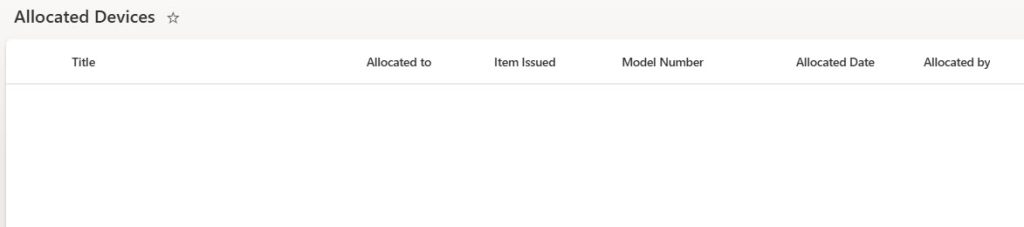
Allocated Devices: Stores details of approved and assigned laptops, with the columns listed below.
| Column Name | Data Types |
|---|---|
| Title | Single line of text |
| Allocated To | Person |
| Item Issued | Choice |
| Model Number | Single line of text |
| Allocated Date | Date/Time |
| Allocated By | Person |
Create the Flow Using a Pre-Defined Approval Template
Power Automate makes this process easy with a pre-defined template that already includes the trigger, approval step, and item creation action. Now follow the steps below:
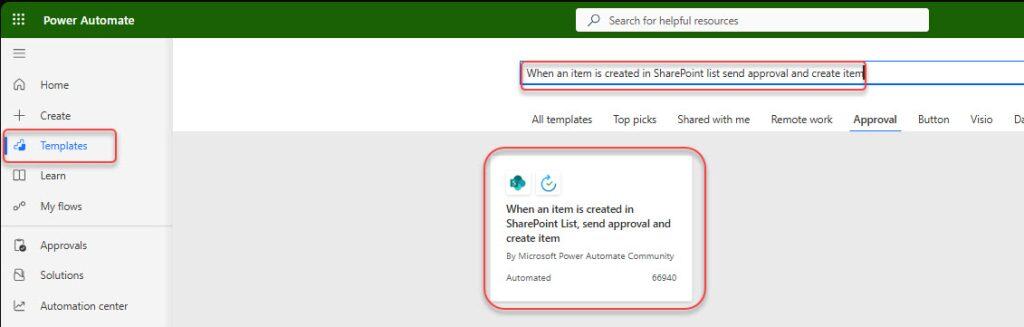
- Open Power Automate, go to the Templates section, and search for “When an item is created in SharePoint list, send approval and create item.” Select this template to get started.
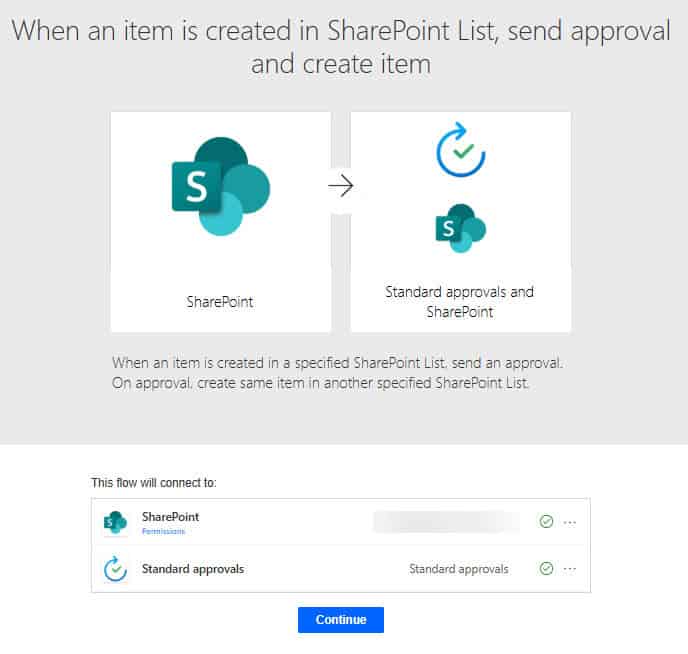
- Next, set up the required connections and click Continue to proceed.
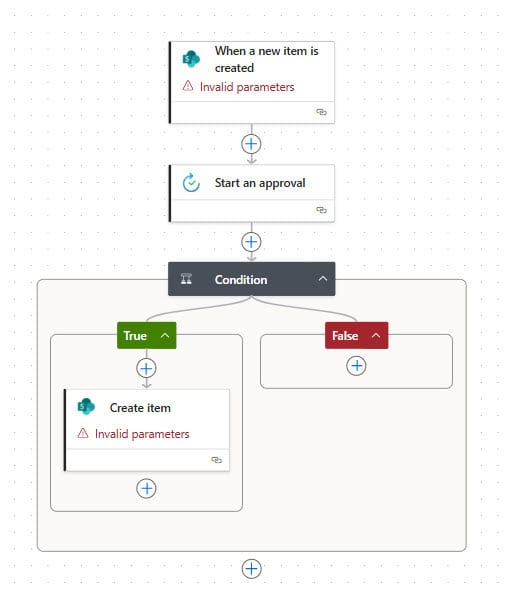
- After clicking Continue, you’ll see the pre-built flow template loaded in Power Automate.
Customize Template Based on the Requirements
- Provide the required details in the When an item is created action by selecting your SharePoint site address and the SharePoint list name.
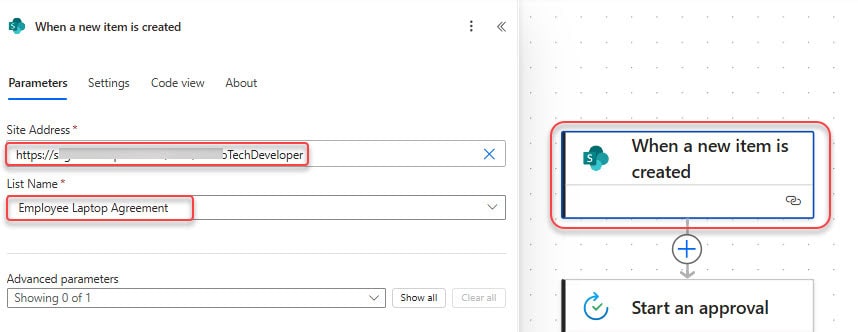
- In the Start an approval action, configure the following:
- Approval type: Approve/Reject – First to respond
- Title: Approval Request
- Assigned to: Enter the Releasing Officer’s email address from the trigger.
- Details: Add the information you want the approver to review before making a decision.
Hello @{triggerBody()?['ReleasingOfficer/DisplayName']},
A new laptop request has been submitted and requires your approval.
Employee Name: @{triggerBody()?['EmployeeName/DisplayName']}
Position: @{triggerBody()?['Position']}
Department: @{triggerBody()?['Department/Value']}
Laptop Requested: @{triggerBody()?['Laptop_x003a__x0020_Model_x0020_/Value']}
Date Released: @{formatDateTime(triggerBody()?['DateReleased'],'dd/MM/yyyy HH:mm tt')}
Remarks: @{triggerBody()?['Remarks']}
You can view the full request using the link below:
[Click Here](@{triggerBody()?['{Link}']})
Please review the request and take the appropriate action.
Thank you,
Power Automate Laptop Request System

- In the Condition action, we don’t need to change anything. We’ll keep it as it is:
@{outputs('Start_an_approval')?['body/response']} id equal to Approve

This condition checks whether the approver selected Approve. If yes, the flow will continue to create the item in the second SharePoint list.
- Click Add an action inside the If yes branch to update the item after the approval response. Select the Update item action and provide the following details:
- Site address: Choose your SharePoint site
- List name: Select the SharePoint list
- Id: Map the ID from dynamic content
- Date released: Select Response date from dynamic content
- Remarks: Enter Approved

- Next, add the Create item action to insert a new record into the Allocated Devices list. Configure it with the following details:
- Site address: Select your SharePoint site
- List name: Choose the target list from dynamic content
- Title: Map the Title from dynamic content
- Allocated to Claims: Select the Employee Name (Claims) value
- Item Issued Value: Select the Laptop value
- Model Number: Choose the Model Number from dynamic content
- Allocated Date: Select the Response date
- Allocated By Claims: Choose the Approver email from dynamic content

- Now, send an email to the requester. Click Add an action -> select Send an email (V2), and configure the following:
- To: Select Employee Name from dynamic content
- Subject: Provide the email subject (Your laptop request has been approved)
- Body: Provide the email body
Hello @{triggerBody()?['EmployeeName/DisplayName']},
Your request for a laptop has been approved. The allocation details are now updated in the Allocated Devices list.
You can check your request status using the following link: Open Request
Thank you,
IT Equipment Team

- If the Request is Rejected (If no branch), click Add an action -> select Send an email (V2). Fill in the parameters:
- To: Select Employee Name from dynamic content
- Subject: Your laptop request has been rejected
- Body:
Hello @{triggerBody()?['EmployeeName/DisplayName']},
Your request for a laptop has been reviewed and rejected by the approving officer, with the Following Comment: @{outputs('Start_an_approval')?['body/comments']}.
Please contact your manager or IT team for further details.
Thank you,
IT Equipment Team

Test the Flow
Once your flow is ready, test it to ensure everything works as expected. Follow these steps:
Go to the Employee Laptop Agreement SharePoint list and create a new item. Fill in all required fields, such as Employee Name, Department, Position, and Laptop requested.

Once the item is created, the flow will trigger automatically. The assigned Releasing Officer will receive an approval request in Outlook and Microsoft Teams.

The officer can Approve or Reject the request.
If approved:
- The item in the Employee Laptop Agreement will be updated with Date Released and Remarks.

- A new item will be created in the Allocated Devices list with the laptop allocation details.

- The employee receives an email notifying them of the approval.

If rejected:
- The employee receives a rejection email explaining that the request was declined.

Conclusion
In this tutorial, we explored how to use the Power Automate template When an item is created in SharePoint list, send approval and create item to automate approval processes efficiently. Instead of making a flow from scratch, we can use Microsoft’s predefined templates in Power Automate and customize them to fit our business needs.
You may also like:
- Create Custom Responses in Power Automate Approvals
- Check if SharePoint Site Already Exists in Power Automate
- Send Approvals in Microsoft Teams Using Power Automate
- Send Approval to SharePoint Group Members Using Power Automate
- Create an Approval Workflow in Power Automate Using Microsoft Forms

Hey! I’m Bijay Kumar, founder of SPGuides.com and a Microsoft Business Applications MVP (Power Automate, Power Apps). I launched this site in 2020 because I truly enjoy working with SharePoint, Power Platform, and SharePoint Framework (SPFx), and wanted to share that passion through step-by-step tutorials, guides, and training videos. My mission is to help you learn these technologies so you can utilize SharePoint, enhance productivity, and potentially build business solutions along the way.