
Last week, when I created a Power BI report for the Finance team, I received the data from SQL. After loading it into Power BI, I noticed that some fields had the wrong data type. For example, a few columns were loaded as text, but they should have been numbers.
To change the data type, Power BI gives us three options: using the Column Tools tab in both Report View and Table View, using DAX, or using the Power Query Editor.
In this tutorial, I will explain the different data types available in Power BI, how to change the data type using the Column Tools tab, and how to change the data type using DAX. I have also already created a separate blog post where I explain how to change the data type using the Power Query Editor in Power BI.
Power BI Data Types
In Power BI, different data types are available to help users manage and understand their data correctly. Here are the common data types:
- Decimal Number: This feature allows for numbers with fractional parts, and the number of decimal places is not fixed.
- Fixed Decimal Number: This feature allows a number with two decimal places.
- Whole Number: This feature allows only whole numbers without any decimal or fractional parts.
- Percentage: This feature allows the use of values to store as percentages.
- Date/Time: This feature allows storing both date and time information.
- Date: This feature allows the storage of only date information.
- Time: This feature allows the storage of only time information.
- Date/Time/Timezone: This feature allows you to store the date and time along with timezone information.
- Duration: This feature allows you to store the time span, such as 2 days 1 hour.
- Text: This feature allows storing words, sentences, or text information.
- True/False: This feature allows you to store boolean values, True or False.
- Binary: This feature allows the storage of binary data.
These are the data types available in Power BI to help you prepare and structure your data correctly before using it in reports and visualizations. Power BI.
Change the Data Type in Power BI
Now, I will tell you how to change the data type in Power BI.
Here, we have a SharePoint list (Financial Sample) that contains below columns with various data types:
| Columns | Data Types |
|---|---|
| Product | Single line of text |
| Country | Single line of text |
| Units Sold | Currency |
| Sales | Number |
| Profit | Currency |
| Gross Sales | Number |
| Sales Price | Currency |
| Segment | Single line of text |
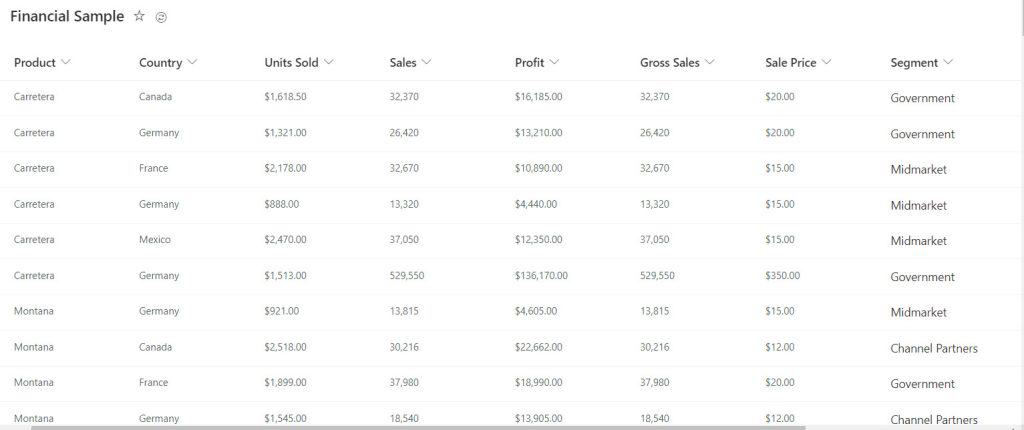
Follow the steps below to change the data types.
- Open Power BI Desktop and load the data using the Get data option. Then, you see data in the Data pane.

- Then go to the table view on the left side.

- Select the column that you want to change. In my case, Units Sold is a Fixed Decimal Number, but I want to use Whole Numbers. You can see this in the Table tools tab.

- From the drop-down, click Whole Number to change the Units Sold column data type to Whole Number.
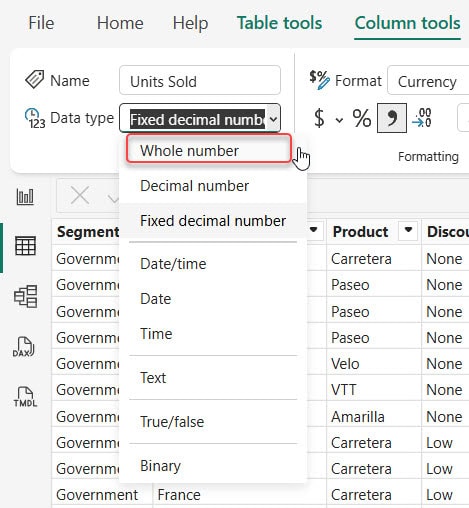
- A message appears asking whether you want to continue. Click yes to apply the change.
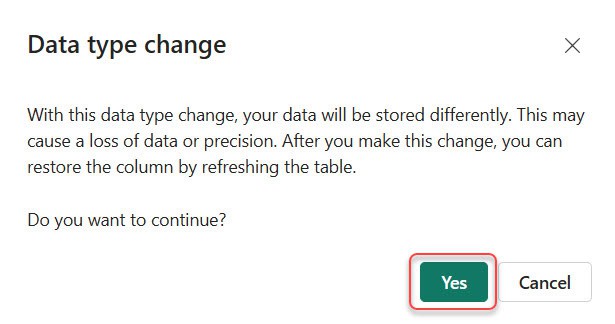
- After that, the Unit Sold column data types change to Whole Number.
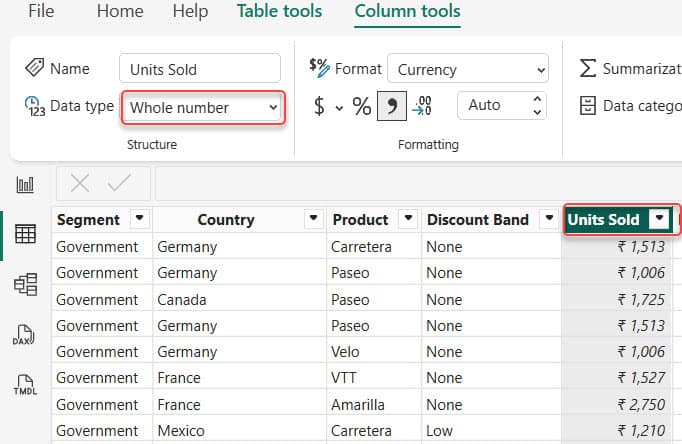
This way, you can change the data type of a column in Power BI.
Change Data Type in Power BI using DAX
Now, I will show you how to change the data type in Power BI using DAX.
- Now, go to the Table view.

Here, you can see that the Sales column is not in currency format, so I want to change it to currency format. To do this, follow the steps below.
- Under the Home tab, click the New column.

- In the formula bar, click the expression below. Then click Commit.
New Sales = CONVERT('Financial Sample'[Sales],CURRENCY)Where:
- New Sales: Name of the Measure
- CONVERT: DAX Function
- Financial Sample: Name of the Table
- Sales: Name of the Column
- CURRENCY: Data Type

- After changing the currency format, you’ll notice a new column added to our dataset with the currency format applied.

You can change the data type in Power BI using DAX using the steps above.
Change Data Type to Integer in Power BI DAX
Now, let’s learn how to convert a currency format to an integer. Follow the steps below to do this.
- Under the Home tab, click the New column.

- In the formula bar, click the expression below. Then click Commit.
New Units Sold = CONVERT('Financial Sample'[Units Sold],INTEGER)Where:
- New Units Sold: Name of the Measure
- CONVERT: DAX Function
- Financial Sample: Name of the Table
- Units Sold: Name of the Column
- INTEGER: Data Type

- After changing the integer format, you’ll notice a new column added to our dataset with the Integer format applied.

This way, we can change the currency format to an integer format in Power BI using DAX.
Conclusion
In this tutorial, you learned what data types are available in Power BI. I also showed you how to change the data type in Power BI in two ways: using the Column Tools tab and DAX.
You may also like:
- Power BI Group by Column
- Add Index Column Using Power Query Editor in Power BI
- How to Convert Date to Text in Power BI
- Power BI Conditional Formatting Based On Field Value
- Difference Between Calculated Column and Measure in Power BI

Hey! I’m Bijay Kumar, founder of SPGuides.com and a Microsoft Business Applications MVP (Power Automate, Power Apps). I launched this site in 2020 because I truly enjoy working with SharePoint, Power Platform, and SharePoint Framework (SPFx), and wanted to share that passion through step-by-step tutorials, guides, and training videos. My mission is to help you learn these technologies so you can utilize SharePoint, enhance productivity, and potentially build business solutions along the way.

